
Ferrara Without the Crowds: A Renaissance City for a Short Italian Break
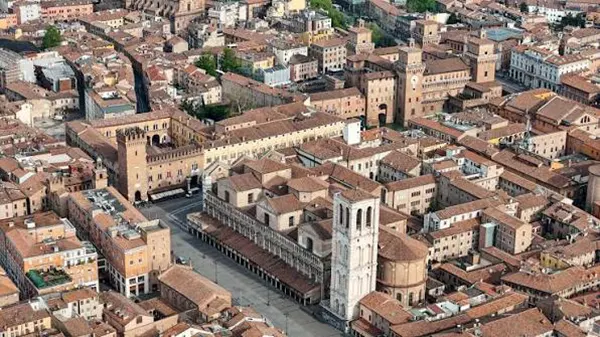
Ferrara offers something increasingly difficult to find on a short trip through northern Italy: a historic city with major Renaissance architecture, serious museums and a strong local identity, yet a centre that can still be crossed at an unhurried pace. The city is in Emilia-Romagna, between Bologna and Venice, and its historic core is compact enough for a two-day stay without reducing the visit to a checklist of monuments. Ferrara’s association with the Este dynasty shaped its castles, palaces, churches, gardens and unusually ordered streets, while its medieval quarter preserves an older, narrower urban character. Tourism is growing — the first half of 2026 recorded further increases in arrivals and overnight stays — so describing Ferrara as completely empty would be misleading. Even so, it remains a convincing choice for travellers who want Renaissance Italy without organising every hour around the visitor pressure found in the country’s most famous art cities.
Why Ferrara Works So Well for a Short Italian City Break
Ferrara’s greatest practical advantage is its scale. The main sights are concentrated inside or immediately around the historic walls, meaning that a visitor staying centrally can spend most of the trip on foot. Castello Estense, Piazza Trento e Trieste, Ferrara Cathedral, the medieval lanes around Via delle Volte and the beginning of Corso Ercole I d’Este are all part of the same walkable central area. Moving between them feels like passing through different chapters of the city’s history rather than travelling between isolated attractions. The result is particularly useful on a weekend or one-night stop: less time is lost on local transport, and there is room for an unscheduled coffee, a bakery stop or an evening walk when day visitors have left the centre.
Ferrara is also easy to fit into a rail itinerary. Its station lies on the Bologna–Padua route, with direct services linking the city to Bologna, Padua and Venice as well as connections to destinations including Florence and Rome. From Bologna, the average rail journey quoted by the official Ferrara tourist information service is around 40 minutes, making the city realistic both as a destination in its own right and as part of a longer Emilia-Romagna trip. Bologna Guglielmo Marconi Airport is around 52 kilometres away, and a direct Bus&Fly connection links the airport with Ferrara in roughly one hour. Travellers arriving from abroad therefore do not need to hire a car simply to make a short visit workable.
The phrase “without the crowds” needs some perspective in 2026. Ferrara is no longer an overlooked destination: municipal figures for January to June 2026 show arrivals up 4.98% and overnight stays up 4.30% compared with the first half of 2025, itself described by the municipality as a record year. Major exhibitions, festivals and holiday weekends can create distinctly busy periods around the castle and central piazzas. The difference is that visitor activity does not normally dominate the whole historic centre. Walking a few streets away from Piazza Trento e Trieste, particularly towards the Renaissance quarter, Via delle Vigne or quieter sections of the walls, quickly changes the rhythm. Travellers seeking calm should favour ordinary weekdays and avoid judging the entire city by a Saturday afternoon during a major event.
A Practical Two-Day Pace Without Rushing
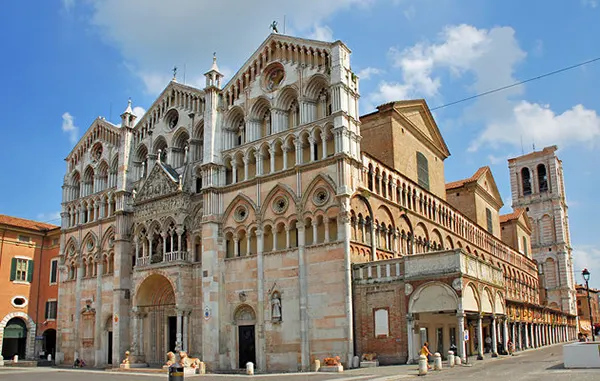
A sensible first day starts around Castello Estense, the four-towered brick fortress surrounded by its moat in the centre of Ferrara. From there, Piazza Savonarola leads naturally towards Piazza Trento e Trieste, the Cathedral and the Palazzo Municipale. The cathedral combines a Romanesque lower façade with later Gothic elements, while its interior reflects substantial changes made in later centuries. Instead of moving immediately to another museum, it is worth continuing south through the older streets around Via San Romano and Via delle Volte. This part of Ferrara is more intimate than the monumental Renaissance avenues: brick arches, narrow lanes and buildings closely aligned with the street reveal the city’s medieval form. It also places visitors near traditional food shops and restaurants, making lunch part of the route rather than a separate excursion.
The second day can concentrate on the planned Renaissance city. Walking north from the castle along Corso Ercole I d’Este is one of the clearest ways to understand why Ferrara holds such an important place in the history of European urban design. Palazzo dei Diamanti is the obvious architectural landmark, but the broad street, long perspectives and relationship between residences and open space are just as important as any individual façade. From here, Piazza Ariostea, the northern walls and the green areas around them can be combined into a relaxed circuit. Later in the day, Palazzo Schifanoia makes a strong second museum choice because its Salone dei Mesi provides direct visual evidence of Este court culture rather than repeating what visitors have already seen inside the castle.
This order can easily be reversed according to museum closing days. In 2026 Castello Estense normally opens from 10.00 to 18.00 and closes on Tuesdays, while Museo Schifanoia normally opens from 10.00 to 19.00 and closes on Mondays. Planning around those two days prevents a common short-break problem: arriving with a fixed itinerary only to find that one of the principal museums is unavailable. Travellers visiting from 19 September 2026 also have another significant option, as Palazzo dei Diamanti is scheduled to host “From Monet to Van Gogh to Kandinsky: New Visions on Nature and Modernity” until 10 January 2027. That exhibition is likely to concentrate more visitors around Corso Ercole I d’Este, so advance booking is sensible when the exhibition is a priority.
Renaissance Ferrara and the Urban Vision That Changed the City
Ferrara’s historical importance is not based simply on owning a collection of Renaissance buildings. UNESCO describes it as the first Renaissance city developed through a complex urban plan, an achievement closely associated with the Este rulers and the expansion known as the Addizione Erculea. From 1492, Duke Ercole I d’Este and architect Biagio Rossetti reshaped the northern part of the city according to principles involving perspective, proportion, open space and carefully organised streets. This did not erase medieval Ferrara. Instead, it created the striking contrast still visible today between the irregular streets of the older southern quarters and the wider, more geometrically ordered Renaissance city to the north. Ferrara was inscribed on the UNESCO World Heritage List in 1995, with the protected area subsequently extended to include the Po Delta cultural landscape.
Castello Estense is the most immediate reminder that the Este story was not always one of elegant court life. The fortress was begun in 1385 after a revolt convinced Niccolò II d’Este that the ruling family needed a more defensible residence. Its moat, towers and drawbridges still communicate that military origin clearly. Over time, however, the building evolved into a ducal residence, and the interiors increasingly reflected the status and ambitions of the Este court. In 2026 the standard full-price museum ticket is €12, with an additional €2 charge for access to the Lions Tower when available. Visitors with limited time should still allow enough space for the interiors rather than photographing the exterior and moving on, because the building explains the transition from fortified medieval rule to the more cultivated image projected by Renaissance Ferrara.
Corso Ercole I d’Este then shows how those ambitions spread beyond an individual palace. The avenue runs through the Addizione Erculea and passes Palazzo dei Diamanti, whose exterior is covered with thousands of pointed marble blocks that create constantly changing patterns of light and shadow. The building now combines its architectural importance with major art exhibitions and the Pinacoteca Nazionale, the National Picture Gallery, whose collection covers Ferrarese painting from the thirteenth to the seventeenth centuries. The street itself deserves time even when no exhibition is booked. Traffic is limited, façades sit farther apart than in the medieval quarter and long visual lines make Rossetti’s planning principles unusually easy to read. This is one reason Ferrara rewards walking: its Renaissance heritage exists in the relationship between buildings, streets and open spaces, not only behind museum doors.
Schifanoia, Jewish Ferrara and the Green Circuit of the Walls
Palazzo Schifanoia is one of the best places to understand the sophistication of the Este court. The residence originated in the late fourteenth century and was substantially enlarged under Borso d’Este during the fifteenth. Its name is traditionally connected with the idea of escaping boredom, reflecting its use as a residence for recreation and courtly entertainment. The principal reason to visit is the Salone dei Mesi, or Hall of the Months, a celebrated fresco cycle associated with artists of the Ferrarese school, including Francesco del Cossa. The imagery brings together court life, astrology, mythology and the organisation of the year, creating something far more complex than simple palace decoration. As of 2026, the museum charges €12 for a standard adult ticket, and admission also covers the Civic Lapidary Museum.
Ferrara’s history also includes one of Italy’s significant Jewish communities, and this part of the city deserves more than a passing reference. The former ghetto centred on Via Mazzini, Via Vignatagliata and Via Vittoria was established in 1627 under papal rule, although Jewish life in Ferrara has much older roots. The Jewish Cemetery near the Renaissance walls contains the grave of writer Giorgio Bassani, whose work is closely connected with twentieth-century Ferrara. MEIS, the National Museum of Italian Judaism and the Shoah, occupies part of the former prison complex on Via Piangipane and presents more than two millennia of Jewish history in Italy. The museum’s location adds another historical layer: during the Second World War, anti-fascists and Jewish prisoners, including Bassani, were detained in the former prison.
The walls provide a very different way of reading Ferrara. Roughly nine kilometres of surviving fortifications surround the historic centre, and much of the circuit can be followed on foot or by bicycle along tree-lined embankments and paths beside the former defensive works. The route passes bastions, gates and sections created or strengthened at different stages of the city’s development, but today it functions as a continuous green belt as much as a monument. Cycling suits Ferrara particularly well because the city is flat and everyday bicycle use is deeply integrated into local life. Hiring a bike is therefore not necessary merely to tick off more attractions; it changes the pace of the trip and makes it practical to combine the northern walls, Parco Urbano Giorgio Bassani and quieter residential areas in a single morning or late afternoon.
Food, Tickets and Practical Choices for Ferrara in 2026
Ferrara’s food makes a short stay feel more specific to the city rather than interchangeable with another stop in northern Italy. Cappellacci di zucca ferraresi IGP are large pasta parcels filled with pumpkin, while salama da sugo IGP is a strongly flavoured pork speciality prepared with wine and spices and traditionally served with mashed potato. Coppia ferrarese IGP, the distinctive twisted local bread, is easy to try without arranging a formal meal. Pasticcio ferrarese is more unusual: pasta, meat sauce and other savoury ingredients are enclosed in a pastry shell that introduces a characteristic sweet-savoury contrast. These dishes have documented links with the culinary traditions that developed around the Este court, so eating locally adds useful context to the palaces and court culture seen during the day.
For travellers planning several paid sights, the MyFE Card is worth comparing with individual tickets rather than buying automatically. In 2026 the official prices are €20 for two days, €22 for three days and €25 for six days. The card includes one visit to a range of participating museums, including Castello Estense, Museo Schifanoia, the Cathedral Museum, the National Picture Gallery, MEIS and other participating sites; it also provides exemption from Ferrara’s tourist tax for qualifying overnight stays. It does not provide priority admission, and Palazzo dei Diamanti’s major temporary exhibition from September 2026 is offered at a reduced price rather than included free. For a two-day visitor paying separately for the castle, Schifanoia and another participating museum, the calculation can already favour the card, but individual opening days should be checked before purchase.
Timing matters almost as much as ticket choice. The central zone around the castle and Cathedral is naturally busiest from late morning into the afternoon, particularly on weekends, public holidays and during major cultural events. An early walk through the medieval streets or a late-afternoon circuit of the walls usually provides a quieter view of the city without sacrificing any major sight. Ferrara is also a place where staying overnight makes a noticeable difference: after day visitors depart, Piazza Trento e Trieste, Via delle Volte and the streets around the castle take on a more local evening rhythm. Autumn and spring are especially comfortable for long walks and cycling, while summer visitors should make use of mornings, shaded streets and the tree-lined wall circuit rather than planning several hours outdoors in the hottest part of the day.
Where Ferrara Fits Into a Wider Italy Itinerary
Ferrara works particularly well between larger destinations. Travellers based in Bologna can reach it by direct train and return the same day, but one or two nights allow enough time to see the city after the busiest daytime hours and to visit more than the central landmarks. Northbound rail services make it possible to continue towards Padua and Venice without returning to Bologna, while direct connections to other Italian cities broaden the options for longer itineraries. This position makes Ferrara useful for travellers who want to vary the rhythm of a holiday: several intensive days in Florence, Bologna or Venice can be followed by a smaller city where the cultural content remains substantial but the logistics are simpler.
Drivers should be more cautious than rail travellers when approaching the centre. Ferrara has controlled parking areas and several ZTL, or limited-traffic zones, including restrictions around the Duomo area, with authorised access required in specified streets. The simplest approach for most visitors arriving by car is to check the current municipal parking information, leave the vehicle outside restricted streets and continue on foot. This is not merely a way to avoid a fine; a car brings little practical benefit once inside the historic area. The main monuments sit within a manageable walking radius, and bicycles are better suited to the walls and green routes. Anyone staying at accommodation inside or close to a ZTL should ask the property about vehicle access before arrival rather than assuming hotel guests may enter automatically.
A short break in Ferrara is best suited to travellers who value architecture, urban history, art, food and long walks more than a dense programme of famous landmarks. Two days are enough to understand the distinction between the medieval city and the Renaissance expansion, visit the castle and at least one major museum, walk or cycle part of the walls and eat several genuinely local dishes. A third day creates room for a slower cultural itinerary or for moving beyond the centre towards the wider Ferrara territory and the Po Delta. Ferrara is attracting more visitors in 2026, so its appeal should not be reduced to the idea of an undiscovered city. Its stronger advantage is more durable: it offers one of Italy’s most important Renaissance urban environments in a compact city where history can still be experienced at a measured pace.