
The Secret Passage of Emperor Commodus in the Colosseum: What Visitors Can See After Restoration
For centuries, millions of people entered the Colosseum without seeing one of its most unusual spaces: a covered underground corridor once reserved for the emperor and members of Rome’s highest elite. Known today as the Passage of Commodus, it allowed the ruler to move between the exterior of the amphitheatre and the imperial seating area without passing through the same entrances as ordinary spectators. Following extensive conservation work, the corridor was opened to the public for the first time in October 2025. By 2026 it had become a special-access section of the Colosseum, giving visitors a rare view of how imperial security, ceremonial movement and luxury decoration worked behind the public spectacle of ancient Rome.
Why the Colosseum Had a Secret Imperial Passage
The Passage of Commodus was not included in the earliest construction plan of the Flavian Amphitheatre. Archaeological evidence indicates that it was added later, around the turn of the first and second centuries AD. Brick stamps found in its masonry suggest construction between the final years of Emperor Domitian’s reign, which ended in AD 96, and the period of Trajan, who ruled from AD 98 to 117. Creating it required significant alterations because the builders had to cut through the existing foundations of a monument that was already in use.
The corridor connected the outside of the Colosseum with the pulvinar, the prestigious area associated with the emperor and the senior hierarchy of the Roman state. It lay at the southern end of the amphitheatre’s shorter north-south axis. The arrangement meant that the emperor could approach his designated place without moving through the dense crowds filling the public entrances and internal passageways. This was useful for security, but it also reinforced the strict social organisation of Roman spectacles: the emperor did not simply have a better seat, but effectively had his own route into the building.
The surviving complex consisted of three main sections. Two arms ran broadly east to west, while another linked them on a north-south line. Light and air entered through openings traditionally described as bocche di lupo, or “wolf-mouth” skylights. Outside the amphitheatre, the route appears to have continued eastwards, although its final destination remains uncertain. Archaeologists have suggested that it may have led towards the training facilities near the Colosseum, including the Ludus Magnus gladiatorial school, or towards the Caelian Hill.
Why It Is Called the Passage of Commodus
The name can be misleading because Emperor Commodus did not order the original construction of the corridor. He ruled from AD 180 to 192, several decades after the passage appears to have been built. Its association with him comes instead from ancient accounts describing an assassination attempt against the emperor within or close to a secluded route in the amphitheatre. The exact identification is not certain, and the Colosseum Archaeological Park itself treats the connection cautiously rather than presenting it as an established archaeological fact.
Commodus nevertheless has a particularly strong connection with the Colosseum. Unlike most Roman emperors, he actively participated in staged performances and gladiatorial displays. Ancient authors describe him fighting animals and appearing in the arena as a gladiator, behaviour that fascinated some contemporaries and scandalised members of the Roman elite. His appearances were carefully controlled performances rather than ordinary gladiatorial contests, but they were an important part of the public image he created during the later years of his reign.
The corridor therefore suits the political atmosphere associated with Commodus even though it predates him. It provided privacy, controlled access and a direct connection between imperial space and the amphitheatre. The ruler could remain physically separated from tens of thousands of spectators before appearing in the ceremonial heart of the building. That contrast between hidden movement and highly visible public display is one reason the restored passage adds so much to an understanding of how the Colosseum actually functioned.
What the Restoration Revealed Inside the Passage
Before conservation work, many of the surviving surfaces were difficult to read. Centuries of damp, pollution, biological growth and exposure had obscured decoration and weakened sections of plaster and stucco. Restoration carried out from 2021 focused on stabilising the structure and recovering the decoration of the first part of the passage and part of the second. That phase was completed in 2025, enabling the corridor to receive visitors. Work connected with the remaining painted surfaces continued afterwards, with further treatment scheduled from spring 2026.
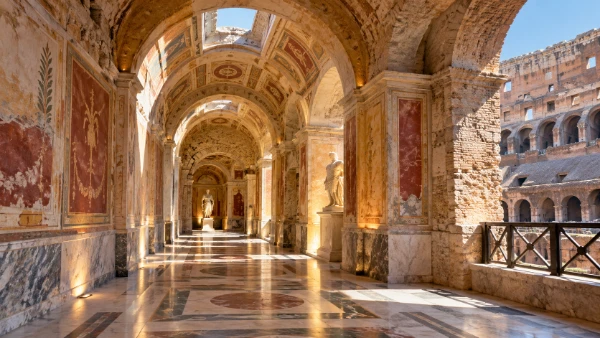
One of the most important results was the clearer identification of the corridor’s luxurious finish. Parts of the walls had originally been faced with marble. The marble slabs themselves have largely disappeared, but traces of the metal fixings that once held them can still be recognised. In later phases, some surfaces received painted plaster, including landscape subjects. These details change the impression of the corridor: it was not merely a practical underground tunnel but an architecturally finished imperial route intended to match the status of the people using it.
The restoration also improved the legibility of the surviving stucco decoration. Conservators removed deposits and biological films, stabilised weakened material and used carefully controlled cleaning methods on delicate areas. Rather than recreating missing decoration as though it were new, the intervention was designed to preserve surviving ancient material and help visitors distinguish what is genuinely Roman. This approach leaves damage and gaps visible while making the original decorative scheme much easier to understand.
Mythological Scenes, Animals and Arena Entertainment
Among the most notable decorative remains are stucco scenes associated with Dionysus and Ariadne. The myth was widely represented in Roman art, but its presence in an imperial route within the Colosseum gives the passage a more sophisticated character than the modern idea of a purely functional escape tunnel. The vault carried mythological imagery, while niches closer to the route towards the imperial seating area included subjects directly connected with amphitheatre entertainment.
Those surviving scenes include references to wild-boar hunts, encounters involving bears and performances in which acrobatic skill accompanied animal displays. Other fragmentary images appear to relate to the doors and mechanisms through which animals could suddenly enter a performance area. Although some portions remain damaged and interpretation has to be cautious, detailed documentation and conservation have enabled specialists to identify elements that were previously much harder to recognise.
The combination is particularly informative. The emperor passed beneath imagery drawn both from mythology and from the entertainment taking place nearby. Marble, painted surfaces and sculpted stucco also show that spaces hidden from most spectators could receive substantial decorative investment. The Colosseum was therefore not divided simply between a spectacular arena and plain service corridors. Status was expressed throughout the building, including in routes that an ordinary Roman spectator would probably never have entered.
What Visitors Can See in the Passage of Commodus in 2026
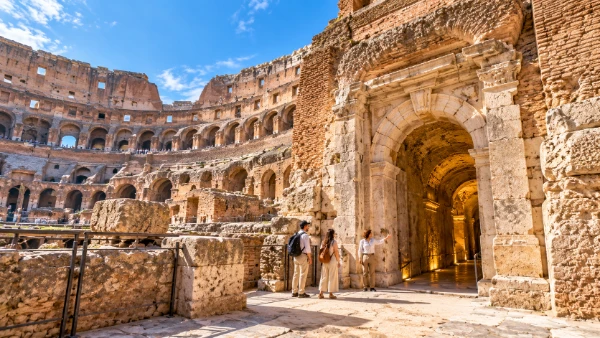
Public access is the most significant change produced by the restoration. The Colosseum Archaeological Park opened the Passage of Commodus to visitors for the first time in October 2025. As of 2026, it is not part of the ordinary entry route: access is provided through the dedicated Full Experience Passage of Commodus option and a guided educational visit. The restricted format reflects both the narrow nature of the ancient corridor and the need to protect fragile archaeological surfaces.
The official visit lasts about 25 minutes and groups are limited to eight people. In the 2026 visitor arrangements published by the Archaeological Park, guided visits are scheduled on Mondays and Wednesdays, with sessions in Italian, English and Spanish. The associated Full Experience ticket remains valid for two consecutive days and also provides access to the Colosseum, Roman Forum, Palatine Hill and included archaeological areas under the conditions of the ticket. Places for the Passage of Commodus can be booked online from seven days before the chosen visit date.
Inside the route, visitors can see the vaulted character of the corridor, surviving ancient wall treatments, restored stucco fragments and the relationship between the passage and the deeper structure of the amphitheatre. Some of the ancient skylight openings have also been made understandable again as part of the presentation of the space. Modern interventions are intentionally recognisable rather than disguised as Roman work, allowing the ancient fabric to remain the main focus.
How the Restored Route Has Been Adapted for Modern Visitors
Opening an underground imperial corridor required more than cleaning its decoration. Parts of the ancient vault had been lost, while changes to the surrounding Colosseum over many centuries altered the original relationship between the passage and the exterior. The visitor route therefore includes modern protective and structural elements intended to make movement safe without pretending to reconstruct every missing Roman feature. Lighting also helps visitors read the shape of the corridor and understand how natural illumination once entered through the openings above.
Accessibility was considered as part of the project. The Archaeological Park installed equipment to help overcome the entrance steps, making the route available to a wider range of visitors. This is especially important in a monument whose ancient changes in level, narrow corridors and stairs can create substantial obstacles. The intervention demonstrates how access can be improved without removing the historic features that give the passage its meaning.
Anyone planning a visit in 2026 should check the official Colosseum booking information shortly before travelling. Access to sensitive sections can change because of conservation requirements, weather or visitor-management measures, and the Passage of Commodus is not normally included on free-admission days. For those able to book the dedicated visit, the restored corridor offers something different from the familiar view of the arena: it shows the private architecture behind imperial spectacle, where political rank, personal security and carefully designed decoration met beneath one of ancient Rome’s busiest public buildings.