
Kisimul Castle in Scotland: How the Medieval Sea Fortress Was Restored in 2026
Standing on a rocky islet in Castlebay, Kisimul Castle is one of Scotland’s most unusual medieval strongholds. Surrounded by the waters of the Outer Hebrides, the 15th-century fortress once served as the ancestral seat of Clan MacNeil and remains an important part of Barra’s heritage. After several years of restricted access and extensive conservation work, the historic landmark reopened to visitors on 22 July 2026. The project addressed structural problems, restored essential features and made guided visits possible again. Its reopening marked a significant achievement for the island community, although continuing repairs mean that access is still carefully managed. The story of Kisimul’s restoration also reveals why preserving a centuries-old building in the middle of the sea presents challenges rarely encountered at mainland castles.
The History of Kisimul Castle and Its Unusual Island Location
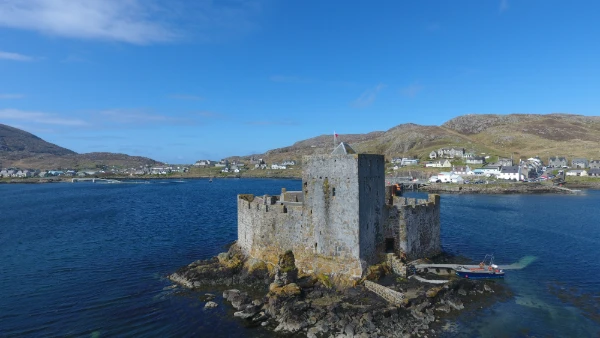
Kisimul Castle occupies a small rocky island in Castlebay, immediately offshore from the village of the same name on Barra. Its position was carefully chosen. Water provided a natural defensive barrier, while the surrounding bay offered access to maritime routes used for trade, communication and military activity. Unlike many Scottish fortifications built on hillsides or overlooking river crossings, Kisimul could only be approached by boat. This arrangement made it difficult for attackers to reach the walls without being noticed. Today, the fortress is especially recognisable for its square tower house, enclosed courtyard and substantial curtain wall rising almost directly from the sea. The setting has changed relatively little, allowing visitors to appreciate how closely medieval architecture was connected to the geography of the Hebrides.
The castle dates primarily from the 15th century and is associated with Gilleonan MacNeil, who received a formal grant of Barra from Alexander MacDonald, Lord of the Isles, in 1427. Although the MacNeils traditionally traced their presence on the island to earlier centuries, the surviving historical evidence places their recognised lordship firmly in the late medieval period. Gilleonan probably established the stronghold that became the family’s principal residence. The MacNeils were part of the wider political and maritime world of the Lordship of the Isles, whose influence extended across much of western Scotland. Their involvement in Gaelic politics, seafaring and regional disputes made an offshore residence particularly useful. Kisimul was therefore more than a defensive structure: it was a visible expression of the family’s authority over Barra.
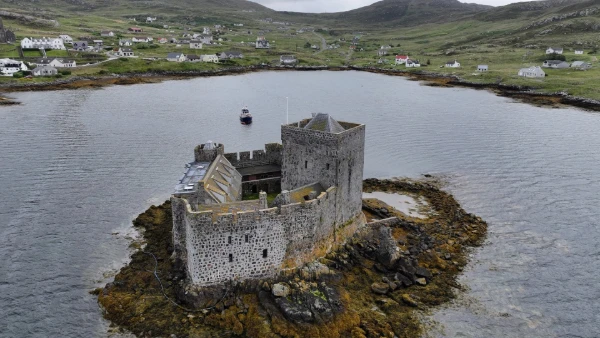
The original complex developed around a three-storey tower house that provided private accommodation for the clan chief. A protective stone wall enclosed a courtyard containing a feasting hall, chapel, watchman’s house and accommodation associated with the chief’s designated heir, known as the tanist. A freshwater well supplied the inhabitants, an especially valuable feature on an isolated site. Near the original landing place stood a building connected with the crew of the chief’s galley. These arrangements reveal how the fortress functioned as a small, organised residence rather than simply a military outpost. Its occupants needed facilities for cooking, sleeping, receiving guests, religious observance and maintaining contact with the wider island. Every available section of rock had a practical purpose.
From the MacNeil Clan’s Stronghold to a Historic Monument
Life at Kisimul reflected the opportunities and dangers of the western seaboard. The MacNeils were accomplished seafarers, and their history includes involvement in disputes that extended far beyond Barra. One particularly colourful figure was Ruari MacNeil, sometimes called Ruari the Turbulent, who became associated with piracy during the reign of James VI. Yet the castle’s importance cannot be reduced to stories of raids and conflict. It also hosted family gatherings, feasts and the everyday activities of an influential Gaelic household. The arrangement of its buildings helps explain the relationship between the clan chief, his relatives, retainers and maritime followers. From the courtyard, the neighbouring settlement and boats entering the bay would have been readily visible.
By the 18th century, Kisimul had lost much of its residential importance and was eventually abandoned. A destructive fire in 1795 contributed to its deterioration, while stone was subsequently removed during the herring-fishing boom, including for use as ballast. Parts of the defensive wall and several courtyard buildings suffered substantial damage. Financial difficulties also affected the MacNeil family, whose chiefs sold Barra in 1838. For decades, the fortress remained a prominent but increasingly ruined landmark. Its survival was never guaranteed: exposure to Atlantic weather, the removal of building materials and the absence of regular maintenance all threatened the remaining structure. The castle visible today therefore represents both medieval construction and later efforts to recover what had been lost.
A major turning point came in 1937, when Robert Lister MacNeil, the 45th clan chief and a trained architect, purchased the Barra estate and began an ambitious programme to restore his ancestral home. Work started in the late 1930s and continued, with interruptions, into the early 1970s. The project repaired extensive damage and reconstructed significant parts of the building complex, including courtyard structures. This intervention saved the monument from further deterioration but also introduced materials and construction methods that would later require attention. Kisimul passed into state care in 2000 and is now managed by Historic Environment Scotland. Its history is consequently shaped by several distinct periods: medieval occupation, abandonment, 20th-century reconstruction and modern conservation.
How Kisimul Castle Was Restored and Reopened in 2026
The conservation programme that enabled Kisimul Castle to reopen in July 2026 was not a complete rebuilding of the medieval fortress. Its principal purpose was to address safety concerns and structural deterioration, particularly problems associated with materials installed during the previous century’s restoration. The castle had been closed to visitors since 2022, and reopening required more than repairing individual sections of masonry. Specialists needed to assess the stability of existing structures, improve safe movement through the buildings and protect vulnerable areas against further deterioration. Historic Environment Scotland began a major phase of essential conservation work in September 2024, following investigations into the condition of the monument and the effects of its exposed maritime setting.
One of the most serious concerns involved reinforced concrete introduced during the 20th-century restoration. In some areas, steel reinforcement had been positioned too close to the surface, leaving insufficient protective covering. Salt and moisture from the surrounding sea gradually contributed to corrosion, while parts of the concrete developed cracks and weaknesses. The conservation team therefore had to deal with problems caused not by medieval construction but by comparatively recent repairs. New supporting arrangements were introduced to improve structural stability, while further inspection of high-level masonry helped identify other areas requiring attention. The work illustrates an important principle of historic building conservation: alterations intended to preserve a monument can themselves become vulnerable as materials age and environmental conditions change.
Access presented another difficulty. Kisimul has no road connection to Barra, so equipment and materials cannot simply be delivered by lorry to the entrance. During the conservation programme, heavy supplies were transported to the island by helicopter, allowing specialist teams to undertake work that would otherwise have been extremely difficult to organise. Weather conditions, limited working space and the need to protect the historic fabric added further restrictions. Contractors also had to consider how modern safety improvements could be incorporated without unnecessarily altering the appearance of the fortress. In a structure surrounded by water, even a relatively straightforward repair requires careful coordination. The 2026 reopening was therefore the result of several years of planning, inspection and practical work rather than a single short restoration campaign.
Structural Repairs, New Stairs and the Castle’s Restored Features
Among the most important improvements was the replacement of the tower staircase. Installation began on 5 November 2025, using a structure manufactured away from the castle and transported to Barra for assembly. The stairs were made with seasoned timber, non-ferrous fixings and stainless components selected for their suitability in the demanding coastal environment. Preparing the individual sections off-site reduced the amount of time specialists needed to spend working inside the monument. The completed staircase restored an essential route through the tower and enabled further internal conservation. It also demonstrated how contemporary craftsmanship can support the continued use of historic buildings without attempting to disguise the practical requirements of modern visitor safety.
Other significant improvements included stabilising the ceiling of the Great Hall, replacing the chapel roof and renewing the elevated walkway along the defensive structure. Repairs were also carried out at the Castlebay jetty, which serves as the departure point for visitors travelling to the castle. The renewed high-level walkway is particularly important because it offers views towards the village and surrounding bay while allowing visitors to appreciate the fortress from above its courtyard. The Great Hall and chapel repairs addressed different needs: one concerned structural safety and access, while the other improved protection against weather. Together, these works strengthened essential parts of the historic complex and helped make supervised tours possible again.
The conservation programme also depended on contributions beyond the organisation responsible for managing the site. The Historic Scotland Foundation received donations organised by the Clan Macneil Association of America, helping to fund elements of the work, including the staircase project. The involvement of the wider clan community demonstrates the continuing cultural importance of Kisimul, particularly among descendants living outside Scotland. On 22 July 2026, Historic Environment Scotland announced that the fortress was once again welcoming visitors. The achievement was substantial, but it did not mean that every conservation issue had been permanently resolved. Additional repairs and maintenance remain necessary, and the visitor experience continues to reflect that ongoing responsibility for the building’s condition.
Visiting Kisimul Castle After the 2026 Restoration
The reopening introduced a supervised visitor experience rather than unrestricted entry. Historic Environment Scotland organised guided tours on selected dates during summer 2026, with the season ending on 30 September. As of November 2026, the castle is closed for winter, and visitors should consult the official website for any subsequent tour announcements. During the reopening season, access was available through advance-booked excursions departing from Castlebay. Each visit lasted approximately one hour, including the short boat crossing. The arrangement allowed people to enter the fortress while conservation work continued, without treating areas still requiring attention as ordinary public spaces. For travellers planning a future visit, confirmed availability is essential because access cannot be assumed throughout the year.
Visitors join the excursion at the Historic Scotland jetty opposite the Post Office in Castlebay, where they are instructed to arrive 15 minutes before departure. The tour begins with a boat journey across the harbour, providing a view of the walls and tower from the water before landing at the fortress. The guided experience explains the building’s medieval history, the role of Clan MacNeil and the recent conservation programme. Some areas may remain inaccessible as repairs continue, so the route can differ from what visitors might expect at a fully restored attraction. The official tour is suitable for people aged seven and over. Hard hats and life jackets are provided, while sturdy footwear and clothing appropriate for changing Hebridean weather are recommended.
Tickets must be purchased online in advance through Historic Environment Scotland, and the operator does not offer same-day ticket sales at the departure point. The booking arrangements include standard admission with the boat crossing, as well as options for families, members and eligible pass holders. Prices and available categories should be checked when reservations for future seasons are released rather than relying on figures from previous years. Travellers should also allow flexibility in their plans. Conditions in the Outer Hebrides can change quickly, and access to a small offshore monument naturally depends on safe operations at the jetty and during the crossing. Anyone arranging accommodation or onward transport around a castle visit should confirm the tour arrangements before finalising their itinerary.
Exploring Barra and Understanding the Castle’s Lasting Importance
Kisimul Castle is situated in the heart of Castlebay, the principal settlement on Barra’s southern coast. The village is a practical starting point for exploring the surrounding area and offers excellent views of the fortress even when boat tours are unavailable. Barra is part of the Outer Hebrides and can be reached by ferry, including the service connecting Oban with Castlebay, or by air through Barra Airport. The airport is famous for scheduled flights that use a tidal beach as a runway, although flights depend on operational and weather conditions. Travellers arriving on the island can combine the castle with visits to nearby coastal scenery, beaches and traditional settlements. For those interested in photography, the harbour provides a clear view of the fortress against the surrounding hills and water.
The restoration has considerable importance for Barra’s residents because the castle is closely connected with the island’s identity. Its silhouette appears across the bay from the village, and the MacNeil story remains part of the community’s historical memory. Reopening the monument restored an opportunity for residents and visitors to experience a site that had been inaccessible for several years. It also created a means of explaining the challenges of protecting historic structures from coastal weather. Guided tours connect architectural history with the wider experience of island life, including local fishing traditions and the social changes associated with the Highland Clearances. This broader context helps visitors understand why Kisimul matters beyond its appearance as a fortress surrounded by water.
The events of 2026 also provide a useful example of how historical preservation continues long after a major restoration has been completed. Kisimul survived medieval conflict, abandonment, the loss of building materials and an extensive reconstruction during the 20th century. Its recent conservation work addressed another chapter in that history by making vulnerable areas safer and restoring access to important parts of the monument. Future maintenance will remain essential because the surrounding marine environment cannot be controlled. For anyone travelling to Barra, Kisimul offers an unusually direct connection between Scottish clan history, island geography and modern heritage conservation. Whether viewed from Castlebay or visited on a guided excursion during an operating season, the castle remains one of the Outer Hebrides’ most distinctive historic landmarks.