
Notre-Dame in 2026: How to Visit the Restored Cathedral and Plan a Route Around Île de la Cité
Notre-Dame de Paris is once again a working cathedral and one of the central stops for visitors to the French capital. After the fire of April 2019 and more than five years of reconstruction and restoration, the cathedral reopened in December 2024. By 2026, visitors can enter the restored interior, attend services and concerts, and once again climb the towers, which reopened separately in September 2025. A visit can also serve as the starting point for a compact walking route across Île de la Cité, taking in Sainte-Chapelle, the Conciergerie, the flower market, Place Dauphine, Pont Neuf and the western tip of the island. Since opening arrangements, security procedures and ticket rules differ between these monuments, planning the order of stops in advance makes a significant difference to how much can comfortably be fitted into one day.
Planning a Visit to Notre-Dame de Paris in 2026
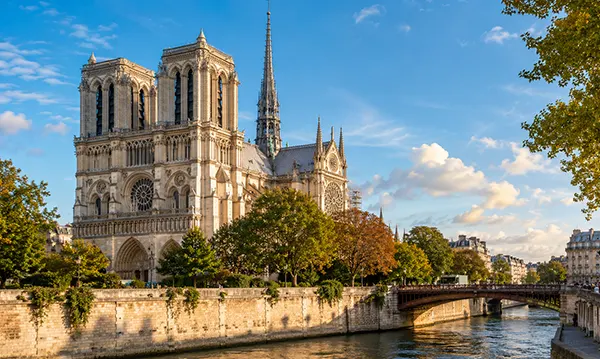
Notre-Dame reopened after a restoration programme that repaired the main damage caused by the 2019 fire while returning many historic features to their previous appearance. The reconstructed oak roof structure and spire restored the familiar exterior profile, while extensive cleaning transformed the interior. Stone vaults, walls, chapels, paintings and decorative elements were cleaned or restored, and new liturgical furnishings were installed before the reopening. The cathedral is therefore not presented as a reconstruction with a noticeably modern interior. Much of the work was intended to recover the appearance and spatial character that existed before the fire, while introducing updated lighting, fire protection and other essential systems. Restoration has not completely ended, however. A longer conservation programme covering parts of the monument that were not central to the emergency post-fire work is scheduled to continue from 2026 onwards, so visitors may still encounter work around sections of the cathedral or its surroundings.
Entry to the cathedral itself remains free in 2026. Notre-Dame is normally open Monday to Friday from 7:50 am until 7:00 pm, with Thursday opening extended until 10:00 pm. On Saturday and Sunday, the usual hours are 8:15 am to 7:30 pm, with final entry 30 minutes before closing. A free timed reservation can reduce waiting, but it is not compulsory for individual visitors. The reservation system releases places progressively, and the live booking page may make slots available only shortly before the visit, so it is more sensible to check the official Notre-Dame reservation service when already in Paris rather than rely on a booking made months in advance. Visitors without reservations can still join the normal admission queue. There is no legitimate paid ticket for ordinary cathedral entry, an important point when comparing offers from tour sellers or intermediaries.
Morning remains the easiest period for fitting Notre-Dame into a longer Île de la Cité itinerary. Arriving close to opening time leaves enough space later in the day for ticketed monuments with shorter hours. The nearest Métro station is Cité on Line 4, while Saint-Michel–Notre-Dame is useful for RER B and C passengers. Châtelet is also within walking distance and serves Métro Lines 1, 7, 11 and 14. Security screening should be treated as part of the visit rather than as an unexpected delay. Large luggage and large bags are prohibited, while backpacks are limited to 20 litres. Notre-Dame is first and foremost an active Roman Catholic cathedral, so services continue throughout the week and parts of the interior may temporarily be reserved for worship. A quieter visit is usually easier outside the principal Mass periods, while anyone specifically wishing to attend Mass should use the dedicated arrangements for worshippers rather than the sightseeing queue.
What to See Inside the Restored Cathedral and Its Towers
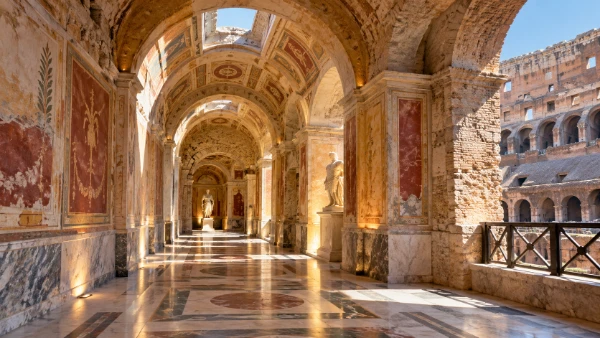
The interior route gives a much clearer impression of the scale of the restoration than the façade alone. Cleaning removed centuries of accumulated dirt from many stone surfaces, giving the nave and side aisles considerably more reflected light. Visitors can see the great nave, transepts, chapels, stained glass and restored artworks while following the designated circulation route. The three medieval rose windows survived the fire and remain among the most significant visual elements of the building. Other features worth giving time to include the Virgin and Child known as the Virgin of the Pillar, the restored choir enclosure, the large seventeenth-century paintings known as the Mays of Notre-Dame and the liturgical arrangement introduced for the reopening. The interior now combines medieval, early modern, nineteenth-century and contemporary elements rather than representing a single period of French architecture.
It is worth allowing roughly an hour for the main cathedral rather than treating Notre-Dame as a short photographic stop. The building remains a place of prayer, and the circulation system is designed to keep visitors moving without blocking chapels or liturgical areas. An official mobile application provides self-guided material, and audioguides are also available on site for visitors who want more explanation without joining a formal tour. The cathedral has made the main visitor route substantially accessible: the central entrance can accommodate wheelchair users, priority arrangements are available for people with disabilities, and adapted interpretation includes tactile and audio resources. There are no public toilets inside Notre-Dame itself, so using facilities before joining the queue is sensible when planning a longer visit.
The towers are a separate attraction with their own ticket and entry system. They reopened on 20 September 2025 and are administered by the Centre des monuments nationaux rather than through the cathedral’s free entry arrangements. In 2026 an individual tower ticket costs €16, and a timed e-ticket is compulsory because tickets are not sold at the entrance. The route involves 424 steps and reaches approximately 69 metres, with narrow passages and no lift, public toilet or water point on the circuit. From 1 April to 30 September the towers are normally open from 9:00 am to 11:00 pm, while from 1 October to 31 March the usual hours are 9:00 am to 5:30 pm, with final admission one hour before closing. The tower visit is therefore best treated as a separate part of the day rather than something automatically included with a cathedral visit, particularly for travellers who prefer a slower walking schedule.
Building a Practical Walking Route Across Île de la Cité
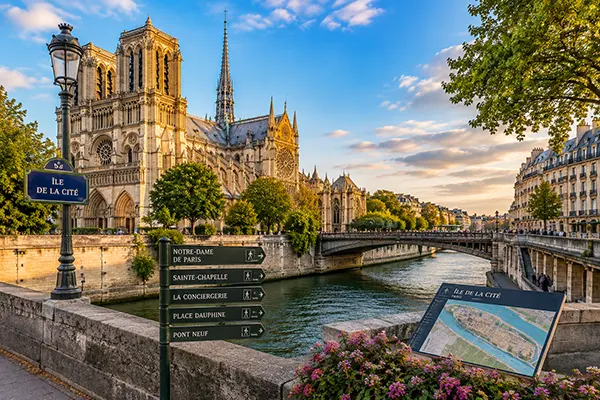
The Notre-Dame forecourt is a natural starting point because several layers of Parisian history are concentrated within a short distance. Before leaving the square, look for the Point zéro des routes de France, the marker traditionally used as the reference point for road distances from Paris. Beneath the forecourt lies the Archaeological Crypt of Île de la Cité, where remains uncovered during twentieth-century excavations document occupation of this part of the city over many centuries. The surrounding public space is undergoing a broader redesign scheduled to continue towards 2027, so temporary diversions or construction boundaries can still affect the most direct walking lines in 2026. From Notre-Dame, head north-west towards Boulevard du Palais rather than crossing immediately to the Left Bank. This keeps the route on Île de la Cité and leads directly towards two of the island’s most important surviving buildings from the medieval royal complex.
Sainte-Chapelle should normally come before the Conciergerie if both are included, particularly during busy periods, because access is tied more closely to timed entry and security procedures. The chapel is open from 9:00 am to 7:00 pm between 1 April and 30 September and from 9:00 am to 5:00 pm between 1 October and 31 March, with last access 30 minutes before closing. From 12 January 2026, individual prices differ according to nationality or qualifying residence within the European Economic Area: the standard individual tariff is €22 for visitors outside the relevant EEA category and €16 for qualifying EEA nationals or residents. A combined Sainte-Chapelle and Conciergerie ticket costs €30 or €23 under the same tariff distinction. These rules make the combined ticket particularly practical when both monuments are already part of the itinerary. Extra time should be left for security because Sainte-Chapelle sits within the Palais de Justice perimeter and entrance checks can add up to around 30 minutes on busy days.
After Sainte-Chapelle and the Conciergerie, continue towards the western end of the island rather than returning directly to Notre-Dame. A short detour around Place Louis Lépine passes the Marché aux fleurs Reine Elizabeth II, the historic flower market near Cité Métro station. From there, Boulevard du Palais leads towards Place Dauphine, the triangular square created under Henri IV as part of the redevelopment associated with Pont Neuf. Walk through the square towards the equestrian statue of Henri IV and Pont Neuf, despite its name the oldest surviving bridge across the Seine in Paris. Steps near the bridge descend towards Square du Vert-Galant at the narrow western point of Île de la Cité. This final section changes the character of the route from monumental interiors to river views and provides a natural place to finish before continuing towards either the Louvre side of the Right Bank or Saint-Germain-des-Prés on the Left Bank.
How Much Time to Allow for the Main Stops
A focused Notre-Dame and Île de la Cité visit can fit into half a day, but only if the towers or one of the other major interiors is omitted. Around 60 minutes is reasonable for Notre-Dame itself after admission, although the queue can make the total longer. Sainte-Chapelle commonly takes about 45 minutes once inside, while the Conciergerie generally benefits from at least an hour because its medieval halls and Revolutionary-era sections cover considerably more ground than the chapel. Walking between these sites takes only a few minutes, but security checks mean that their proximity on a map can be misleading when calculating a schedule. Place Dauphine, Pont Neuf and Square du Vert-Galant do not require tickets and can be covered in around 30 to 45 minutes, or considerably longer if the route includes a break beside the Seine.
For a straightforward half-day itinerary, start at Notre-Dame near 8:00 or 8:30 am on a weekday, spend about an hour inside and then walk to Sainte-Chapelle for a timed entry around 10:00 am. Continue directly to the Conciergerie before midday, then pass the flower market and Place Dauphine on the way to Pont Neuf. This order puts the most important timed and security-controlled stops early in the schedule while leaving the outdoor section flexible. It also avoids the common mistake of spending the first part of the day walking around the island and reaching Sainte-Chapelle only when the queues and security delays are at their heaviest. Travellers visiting between October and March should be particularly careful with timing because Sainte-Chapelle closes at 5:00 pm during this period.
A fuller itinerary requires most of the day, especially when the Notre-Dame towers are included. One practical arrangement is to visit the cathedral first, continue through Sainte-Chapelle and the Conciergerie before lunch, and reserve the towers for the afternoon or early evening. Between April and September, the towers’ late opening makes this much easier because a later slot leaves the daytime hours free for monuments that close earlier. The 424-step ascent should still be taken into account before placing it at the end of a long walking day. Travellers who prefer a less demanding schedule can omit the towers and spend the extra time around the quays, the western tip of the island or the Archaeological Crypt. The important point is not to count every stop simply because the island is small: admission procedures, historic interiors and periods of quiet observation take much longer than the physical distance between buildings suggests.
Making the Île de la Cité Route Work in Real Conditions
The best day for this route depends more on monument schedules than on walking distance. Notre-Dame operates every day, but Sainte-Chapelle, the Conciergerie and other attractions may have holiday closures, exceptional changes or modified access during major events. Notre-Dame itself can also alter visitor circulation for important religious celebrations. Checking the official daily schedule shortly before travelling is therefore more useful than relying on a timetable saved several months earlier. Thursday has one practical advantage because Notre-Dame normally remains open until 10:00 pm, allowing the cathedral to be placed later in the itinerary. In summer, the towers also stay open until 11:00 pm, creating more flexibility. At the same time, hot weather, storms or other safety conditions can cause temporary changes, particularly for the tower circuit.
Accessibility needs can change the order and content of the route. The main Notre-Dame visitor circuit accommodates wheelchair users and includes priority arrangements, while Sainte-Chapelle provides access for visitors with reduced mobility. The Conciergerie states that it is not fully equipped with PRM access, so its current accessibility information should be checked before purchasing a combined ticket. The Notre-Dame towers are the most demanding part of the route: there is no lift, the circuit contains 424 steps, and some passages are only about 45 centimetres wide. Visitors with limited mobility, vertigo or certain health conditions should therefore treat the tower climb as optional rather than an essential part of seeing Notre-Dame. The outdoor journey from the cathedral to Place Dauphine and Pont Neuf provides another way to appreciate the island without adding a strenuous climb.
Practical preparation is simple but important. Carry only a small day bag because Notre-Dame, Sainte-Chapelle, the Conciergerie and the towers all operate security controls and restrict bulky luggage or potentially dangerous items. Keep timed tickets available on a phone before approaching the Palais de Justice area, and do not schedule consecutive entries with only a few minutes between them. Comfortable footwear matters more than the short map distance suggests because a full route can combine several hours of standing, stone staircases and riverside walking. In warmer months, water is useful for the outdoor sections, although food and drink should not be consumed inside the cathedral. Most importantly, leave some spare time between the final ticketed visit and the walk to Pont Neuf: Île de la Cité works best when the itinerary includes both its major monuments and the quieter streets, squares and river edges that connect them.
A Sensible 2026 Itinerary for First-Time Visitors
For a first visit, a balanced route begins with Notre-Dame rather than trying to make the cathedral the final stop. Arrive in the morning, allow time for security and spend about an hour following the main interior circuit. Pause on the forecourt afterwards to see the façade and Point zéro, then walk towards Boulevard du Palais. Book Sainte-Chapelle as the first fixed-time attraction and follow it with the Conciergerie. The two monuments explain a part of Île de la Cité that Notre-Dame alone cannot: this was not simply a religious centre but also the seat of royal government and, centuries later, a major location in the judicial and Revolutionary history of France. Keeping these visits together also reduces unnecessary movement back and forth across the island.
After the indoor monuments, use the second part of the route for places that do not depend on reservations. Pass the flower market, walk through Place Dauphine and continue to Pont Neuf and Square du Vert-Galant. From the western tip of the island, the Seine divides around Île de la Cité before continuing through central Paris, giving a particularly clear sense of the island’s position between the Right and Left Banks. Travellers with an evening tower reservation can then walk back towards Notre-Dame along the southern or northern quay. Those without a tower ticket can finish at Pont Neuf and cross towards the Louvre, or use Pont Neuf and nearby bridges to continue into Saint-Germain and the Latin Quarter.
This sequence also leaves room for the unexpected conditions that are normal in central Paris: security queues, temporary closures, religious ceremonies, road controls and ongoing work around the Notre-Dame surroundings. In 2026 the cathedral is fully back in public use, but both its conservation programme and the redesign of the surrounding public spaces continue beyond the reopening itself. Treating published hours as a framework rather than a minute-by-minute guarantee produces a more reliable itinerary. With Notre-Dame, Sainte-Chapelle, the Conciergerie and the western end of Île de la Cité arranged in a logical order, visitors can cover the island’s principal historic sites without turning a relatively compact part of Paris into an unnecessarily rushed day.