
Pompeii (Pompeii), Italy: how to read the city’s ruins and what not to miss
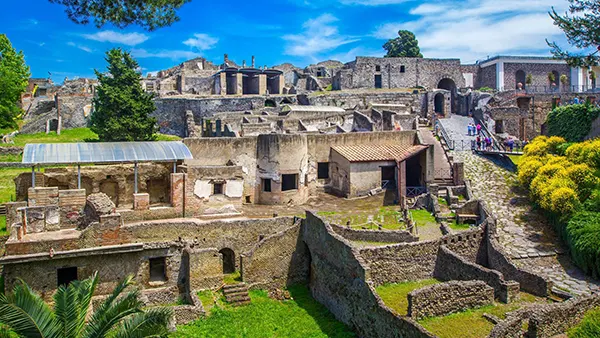
Pompeii isn’t a set of “nice ruins” where you simply tick off big landmarks. It is a street-by-street record of a living Roman town stopped mid-routine, with clues left in kerbstones, shop counters, wall scribbles, drainage channels and door thresholds. If you learn a few simple ways to read what you’re seeing, the site stops feeling like a maze and starts feeling like a neighbourhood with rules, habits and status markers. This guide focuses on how to interpret those details, plus a practical route and a shortlist of places that are genuinely worth your time.
Start with the basics: tickets, time slots, and how to avoid losing time at the gate
As of 2026, Pompeii uses named (personal) tickets, and you should expect to show ID if asked. Entry is organised by time slot, so it helps to think about your visit as a “morning half” or “afternoon half”, rather than an open-ended wander. In peak seasons, buying ahead is not a luxury; it is the difference between starting inside the city at 09:15 and starting at midday with the crowds already thick on the main roads.
The main ticket prices changed from 12 January 2026. A standard Pompeii ticket is €20, while “Pompeii+” is €25 and includes the suburban villas (including the Villa of the Mysteries and Villa Diomedes), plus Villa Regina and the Antiquarium in Boscoreale. There is also a 3-day ticket for €30 and a season ticket (“My Pompeii Card”) for €45. Under-18s are free, and EU citizens aged 18–25 have a reduced ticket of €2; the first Sunday of the month remains free. These figures matter because they should influence your route: if you have Pompeii+, you should deliberately plan time for the suburban area instead of leaving it as a “maybe”.
Time slots are not identical all year. The official visitor regulations set a winter pattern (15/10–15/03) with a second slot that ends earlier than in the warmer period (16/03–14/10). There is also an official daily cap of 20,000 admissions, split across the slots. In plain terms: if you arrive late and expect to buy on the spot, you are gambling with your own schedule, especially from spring to early autumn.
What to pack and what to leave behind (rules that actually trip people up)
Pompeii is uneven underfoot, with drops, gaps and worn stone surfaces that behave like ice when polished by thousands of shoes. Comfortable shoes with grip are not advice for beginners; they are a basic safety measure. The regulations also make it clear that visitors are expected to follow marked itineraries and not improvise shortcuts through blocked areas, even if they look tempting on a map.
Behaviour rules are stricter than many people assume. Touching frescoes, fittings and surfaces is forbidden, and so is getting too close to fragile elements. Sound carries in the narrow streets and courtyard spaces, so loud audio is not allowed. If you are visiting in a group, note the official limit: organised groups over 35 are not admitted, and for groups above 15, an earpiece/whisper system is mandatory.
Another practical point: your ticket is personal and non-transferable, and the Park can carry out checks during the visit. That matters for anyone thinking of splitting up and swapping tickets later in the day, or “handing down” a ticket. Plan your entry like airport boarding: arrive with your ID, ticket details, and a clear idea of which gate you are using.
How to “read” Pompeii like a town, not a museum: street logic, water logic, social logic
The fastest way to make Pompeii feel coherent is to read it in layers. Start with the street layer: ruts in the stone show where carts repeatedly ran; stepping stones hint at how pedestrians crossed when water and waste flowed along the edges. Door thresholds and kerb heights tell you how buildings separated private space from the street, and why some entrances feel grand while others are narrow and practical.
Next comes the water and services layer. Look for channels and gradients: Pompeii’s streets are engineered to move water away from key spaces, and the “busy” streets often have more obvious drainage solutions. Baths are your shortcut to understanding Roman hygiene, social habits and engineering at once. In bath complexes, notice the sequence of rooms, the changing areas, and how the architecture controls movement and temperature rather than simply providing a place to wash.
Finally, read the status layer inside houses. A large entrance does not automatically mean “most important”; what matters is what happens after the door. Atriums, impluvia, peristyle gardens, domestic shrines, wall painting quality and floor mosaics all point to social standing and taste. Once you start reading those choices, a house stops being “a house” and becomes a message: who lived here, how they wanted to be seen, and what they could afford.
Small details that unlock big meaning (and are easy to miss)
Shop counters are one of Pompeii’s best everyday clues. Many shops open directly onto the street and have built-in counter shapes designed for serving and storage. If you see a concentration of these along a road, you are probably on a commercial artery rather than a purely residential lane. Pair that with street width and you can often guess where foot traffic used to be heaviest.
Graffiti is another shortcut to the human scale. Walls carry scratches, slogans and messages that remind you the city was loud, competitive and very personal. Even when you can’t translate every line, you can still learn from placement: public areas attract public statements; quieter corners attract private marks. Treat them like social media posts carved in plaster, not like “decor”.
In homes, keep an eye out for domestic shrines (lararia) and for dining-room layouts that frame a garden or artwork. That is a practical way to read Roman priorities: religion at home, display when entertaining, and a strong connection between indoor rooms and open-air space. If a room has the best wall painting but a tight entrance, that is not an accident; it is controlled access, designed to impress the right people at the right moment.
A route that works in real life: what not to miss, and where to spend your attention
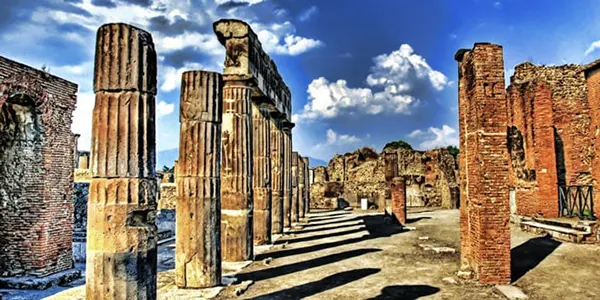
If you want a route that makes sense, choose a loop rather than a zig-zag. The centre of gravity is the Forum area: it helps you orient yourself, and it explains the civic structure of the town. From there, moving along major streets gives you a readable sequence: civic spaces, commercial stretches, then residential zones with richer decoration as you approach major houses.
The unmissable set for most visitors is consistent because these places explain different sides of Pompeii. The Forum and its surrounding buildings give you politics and public life. The bath complexes give you engineering and social routine. One or two major houses give you private wealth and aesthetics. Add at least one theatre space or the amphitheatre area to understand entertainment and crowd management in a Roman town.
When choosing houses, pick for contrast rather than quantity. A single well-preserved elite house can teach you more than five smaller stops where you rush through doorways without noticing the plan. Also, be ready for changes: individual buildings can have maintenance work or a revised visitor flow, so your “must-see” list should be a shortlist, not a rigid schedule.
Three high-value stops that reward careful looking (plus a simple way to pace them)
House of the Faun is worth the effort because it is a lesson in elite domestic architecture and visual ambition. It is big enough that you can feel the hierarchy of spaces: public-facing areas, transitional courtyards, and more private zones. Don’t sprint for a single photo; walk it like a host would lead a guest, and the plan starts telling a story.
The Villa of the Mysteries (included with Pompeii+ in 2026) is a strong choice when you want art that still has emotional impact. The setting outside the main urban grid also helps you reset your sense of Pompeii’s scale: you are not only visiting a town, you are visiting a wider territory of villas, farms and roads that fed it. If you have limited time, this is often a better “extra” than squeezing in several minor houses inside the walls.
For pacing, use a simple rhythm: one civic cluster, one domestic cluster, one “big narrative” stop. That usually looks like Forum area first, then a major house, then a villa or amphitheatre zone depending on your ticket and energy. You will see more by taking deliberate breaks in shade, checking your map at fixed landmarks, and treating the main roads as navigation spines rather than as the only places worth walking.